Key takeaways
- Google My Business is now Google Business Profile, and in 2026 Google's AI (Ask Maps, launched in India in March) reads your profile before recommending anyone
- The Q&A section and its API were discontinued in November 2025 — customer questions are now answered by AI from your profile and website
- An AI agent can safely handle review replies, weekly posts, photo uploads, monitoring and reports
- Google's April 2026 rules ban review incentives, gating, staff-name requests and AI-written reviews — the agent must never touch these
- Let the agent reply to positive reviews alone, but always route 1–3 star replies and profile changes to a human
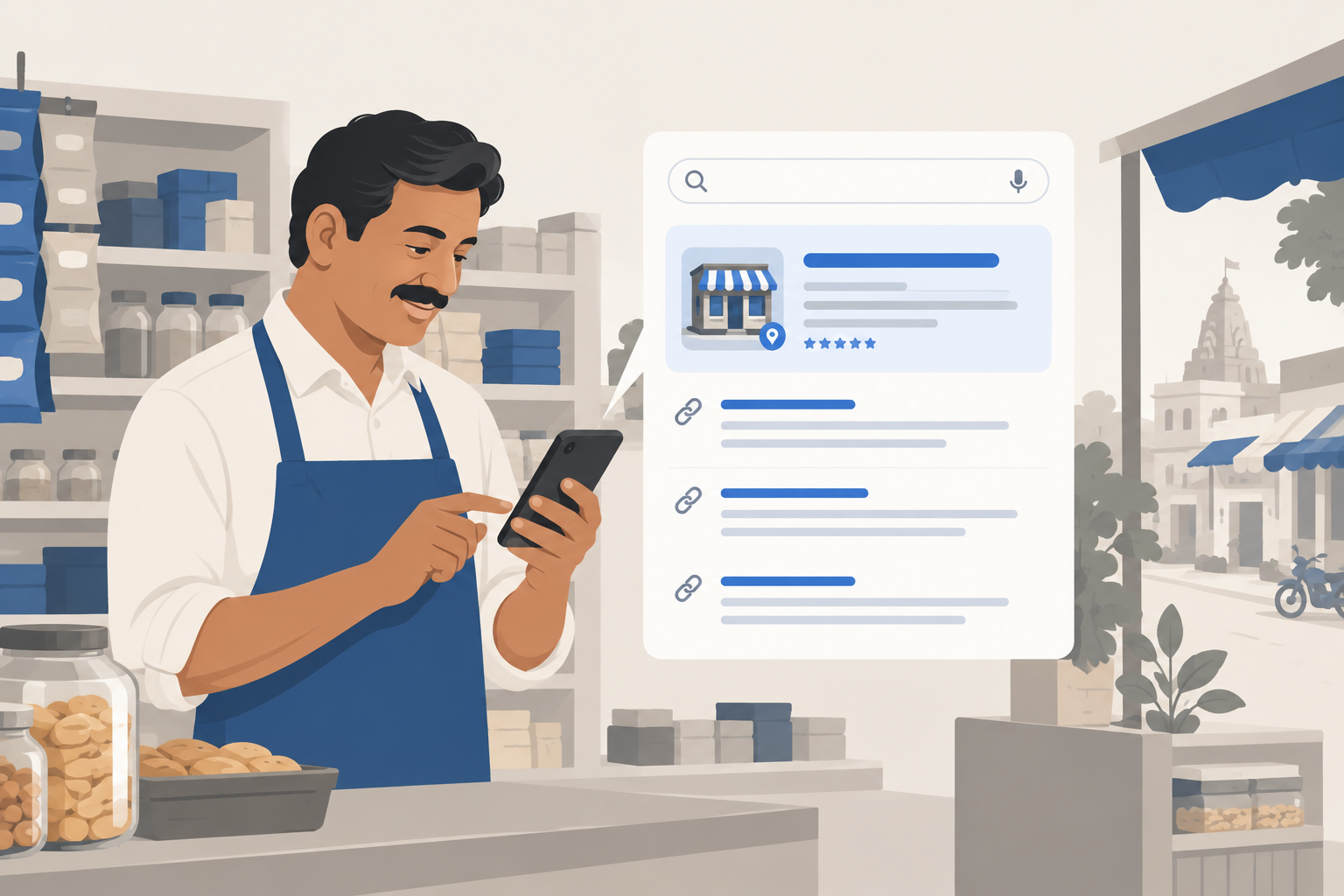
An AI agent for Google My Business is the fix for the most common local SEO problem in India: a Google listing that was created once, verified, and then left alone. No new photos since the opening. Reviews from last year still waiting for a reply. Diwali hours never updated.
Google has noticed. In 2026 your listing is no longer just a pin on a map — it is the raw material Google's AI reads before it recommends anyone. This guide explains what an AI agent can safely run on your profile, what Google's new rules forbid, and how Indian businesses should set one up.
A quick note on names: Google My Business was renamed Google Business Profile in 2021. Most owners still search for the old name, so we use both here. They mean the same listing.
Why your Google listing matters more in 2026#
Two changes this year turned a "nice to have" listing into a front door.
Ask Maps arrived in India. On 12 March 2026, Google launched Ask Maps, a Gemini-powered feature inside Google Maps, in the United States and India at the same time. Instead of typing "dentist near me", people now ask full questions — "a dentist open on Sunday who does kids' check-ups, near Sector 4" — and Maps answers with a recommendation. Hindi support followed. The AI builds that answer from your profile: categories, services, hours, attributes, photos and, above all, the text of your reviews. A thin profile simply does not get mentioned.
The Q&A section is gone. Google discontinued the Q&A API on 3 November 2025 and has been removing the Q&A box from listings since. The old trick of posting your own questions and answering them with keywords no longer exists. Customer questions are now answered by Google's AI, using whatever your profile and website say. If your information is outdated, the AI will confidently repeat the outdated version.
The practical result: a complete, active, recently-updated profile is what gets recommended. Keeping it that way every week is exactly the kind of repetitive work an agent is good at.
What an AI agent for Google My Business actually does#
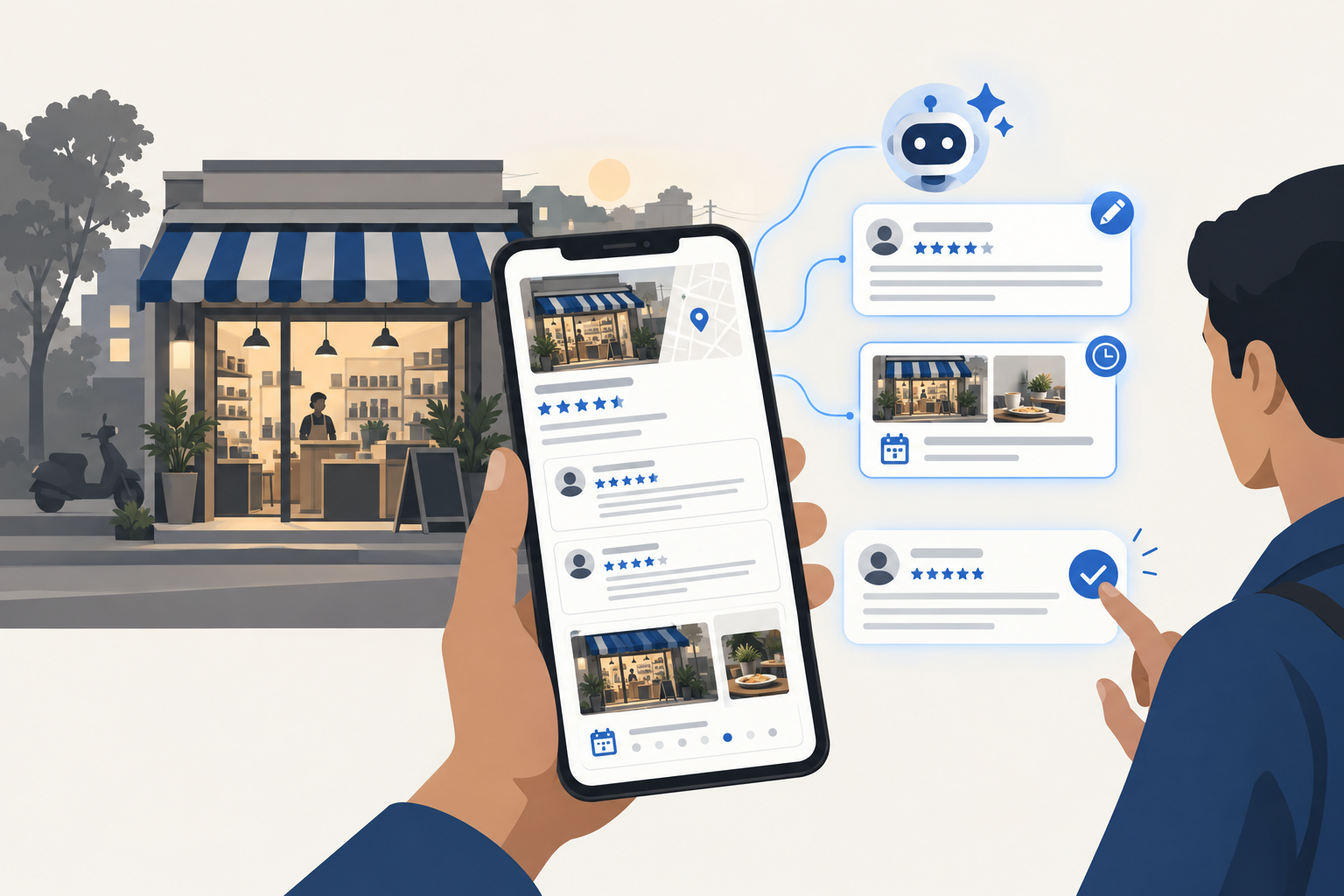
A chatbot writes text when you ask. An agent connects to your profile through Google's Business Profile API, watches for events and completes the task. For a local business, that means five jobs:
- Review replies. Every new review is picked up, sentiment is read, and a reply is drafted in your tone — mentioning what the customer actually wrote, not a generic "Thanks for visiting!"
- Weekly posts. Offers, new stock, festival hours and events are posted on a schedule, so the profile never looks abandoned.
- Photo uploads. New product or work photos from your team's WhatsApp group or shared folder are pushed to the listing.
- Profile monitoring. Hours, phone number, categories and "suggested edits" from the public are checked, and you are alerted if something changes without your approval.
- Performance reports. Calls, direction requests, website clicks and the search terms people used are pulled into a simple weekly summary.
Google itself is moving the same way. Since March 2026 it has been testing a built-in "Reply to reviews with AI" option inside Business Profile, with the test confirmed in India. Commercial tools such as Semrush's GBP AI Agent, Merchynt's Paige and Local Falcon's agent now automate posts, replies and audits for agencies. The idea is no longer experimental.
What Google's 2026 rules forbid (read this before automating)#
This is where most "set it and forget it" tools get businesses into trouble. Google tightened its review and rating manipulation policy in April 2026, and enforcement is now AI-driven. Google says fake reviews on Maps grew 21% in 2025, and it removed or blocked hundreds of millions of policy-violating reviews in a single year. It is actively looking.
Your agent must never:
- Write or post reviews, for you or against a competitor. AI-written review text is removed regardless of whether the experience was real.
- Offer anything for a review — no discount, cashback, loyalty points or free service, including for changing a negative review.
- Gate reviews. Sending the Google link only to customers who said they were happy, and routing unhappy ones to a private form, is prohibited.
- Ask for specific content, such as naming a staff member, or set review quotas for staff. Both were explicitly banned in April 2026.
- Stuff keywords into replies. Replies packed with "best salon in Bokaro" style phrases are against the reply guidelines and read as spam to customers.
What is allowed: asking every customer, the same way, for honest feedback with a direct review link. An agent can do that reliably — for example, sending the link on WhatsApp after every bill — which is far better than staff remembering to ask only the friendly customers.
The human-approval rule that keeps you safe#
The single most important design decision is where the agent stops and a person takes over. We set it up like this:
| Task | Agent acts alone | Human approves first |
|---|---|---|
| Reply to 4–5 star reviews | Yes | — |
| Reply to 1–3 star reviews | — | Always |
| Scheduled offer and festival posts | Yes, from an approved calendar | New offers |
| Photo uploads | Yes, from an approved folder | — |
| Hours, phone, category or name changes | Never | Always |
| Weekly performance report | Yes | — |
A negative review is a public conversation with every future customer who reads it. A good agent drafts the reply, flags it on WhatsApp, and waits. The owner edits one line and sends. That thirty seconds of human judgment is what separates a trusted business from one that sounds like a vending machine.
Buy a tool or build your own agent?#
Ready-made SaaS tools suit a single location that just wants posts and reply drafts. They are quick to start, usually billed per location per month in dollars, and mostly designed around the US market.
A custom agent makes sense when the listing needs to talk to your other systems. That is where most Indian businesses get real value:
- Your billing software or POS triggers the review request after each sale, so every customer is asked the same way
- Your WhatsApp Business number receives the approval alerts for negative reviews
- Replies and posts are written in Hindi, English or Hinglish to match how your customers actually write
- One dashboard covers multiple branches, with reports in your language
One technical point worth knowing: Google gates the Business Profile API behind a separate access approval, even after you enable it in Google Cloud. Plan a couple of weeks for that before any custom build goes live.
For cost, a starter automation that connects your listing to WhatsApp and handles reply drafts and weekly posts typically sits in the same range as other small business automations — roughly ₹15,000 to ₹35,000 one-time, plus modest monthly AI usage. A multi-branch agent connected to billing and CRM moves into custom-agent territory. Our guide to AI agents for small business in India breaks down those ranges in more detail.
A 30-day setup plan#
Week 1 — fix the foundation. No agent can rescue a broken profile. Pick the most specific primary category, list every service with a real description, add current hours including upcoming festival hours, and upload recent photos of your actual shop, team and work.
Week 2 — connect and test. Give the agent manager access (never owner access) to the listing. Run it in draft-only mode: it writes replies and posts, you approve everything, and you tune its tone.
Week 3 — switch on the safe tasks. Let it reply to positive reviews and publish from an approved post calendar. Start the review-request message after every bill.
Week 4 — measure. Compare calls, direction requests and website clicks against the month before. Check how many reviews came in and how fast they were answered. If nothing moved, the problem is usually the profile content, not the agent.
With Navratri and Diwali weeks away, this is also the right time to get festival hours and offers scheduled in advance. Our festive season checklist for small businesses covers the rest of that preparation.
Getting an AI agent for Google My Business built with Larwell#
At Larwell Technologies we build AI agents that plug into the systems Indian businesses already run — Google Business Profile, WhatsApp, billing software and CRM — with approval rules designed around Google's current policies. If you already use a WhatsApp chatbot for your business, the same number can carry your review alerts and approvals.
We work with shops, clinics, restaurants and service businesses in Bokaro Steel City, Ranchi, Dhanbad, Jamshedpur and across Jharkhand, and with clients nationally. The first conversation is simple: we look at your current listing and tell you what is costing you calls.
Keep the profile complete, answer every review honestly, and let the agent handle the repetition. That is how an AI agent for Google My Business turns a forgotten listing into your busiest salesperson.