Key takeaways
- You don't join ONDC directly — you sign up on a seller app, which puts your catalogue in front of buyers on many apps such as Paytm, Magicpin and Mystore.
- On a ₹1,000 order, expect roughly ₹935 in your bank after buyer app fee, seller app fee, GST on those fees, and TCS/TDS — and ₹6 of that deduction comes back at tax time.
- ONDC works best for grocery, food and packaged goods sellers who can deliver locally. It rarely sends orders on its own — you still have to bring customers.
- Nobody needs to be paid to 'register you on ONDC'. A genuine seller app charges you only when you sell.
Every few months a shop owner asks us the same question: "Should I put my shop on ONDC?" Usually someone has told them it is the government's answer to Amazon and Flipkart, with tiny commissions and lakhs of customers.
Part of that is true. ONDC is now a large network. According to a Government of India factsheet, by June 2026 it had over 20 crore buyers, about 5 lakh sellers, presence in around 1,000 cities and close to 90 lakh transactions a month. In July 2026 it crossed 500 million cumulative transactions.
But here is the number the excitement leaves out: as per PIB data, only around 2 lakh merchants had completed even one transaction on the network by the end of 2025. Getting listed is easy. Getting orders is the real work.
This guide explains how to sell on ONDC step by step, what you actually keep from each order, and who it genuinely works for.
What ONDC actually is (in one minute)#
ONDC — the Open Network for Digital Commerce — is not an app or a marketplace. It is a set of shared rules that lets different apps talk to each other.
- Buyer apps are where customers shop: Paytm, Magicpin, Mystore, ONDC's own store and many others.
- Seller apps are where you sign up, list products, receive orders and get paid.
- Logistics providers pick up and deliver if you don't deliver yourself.
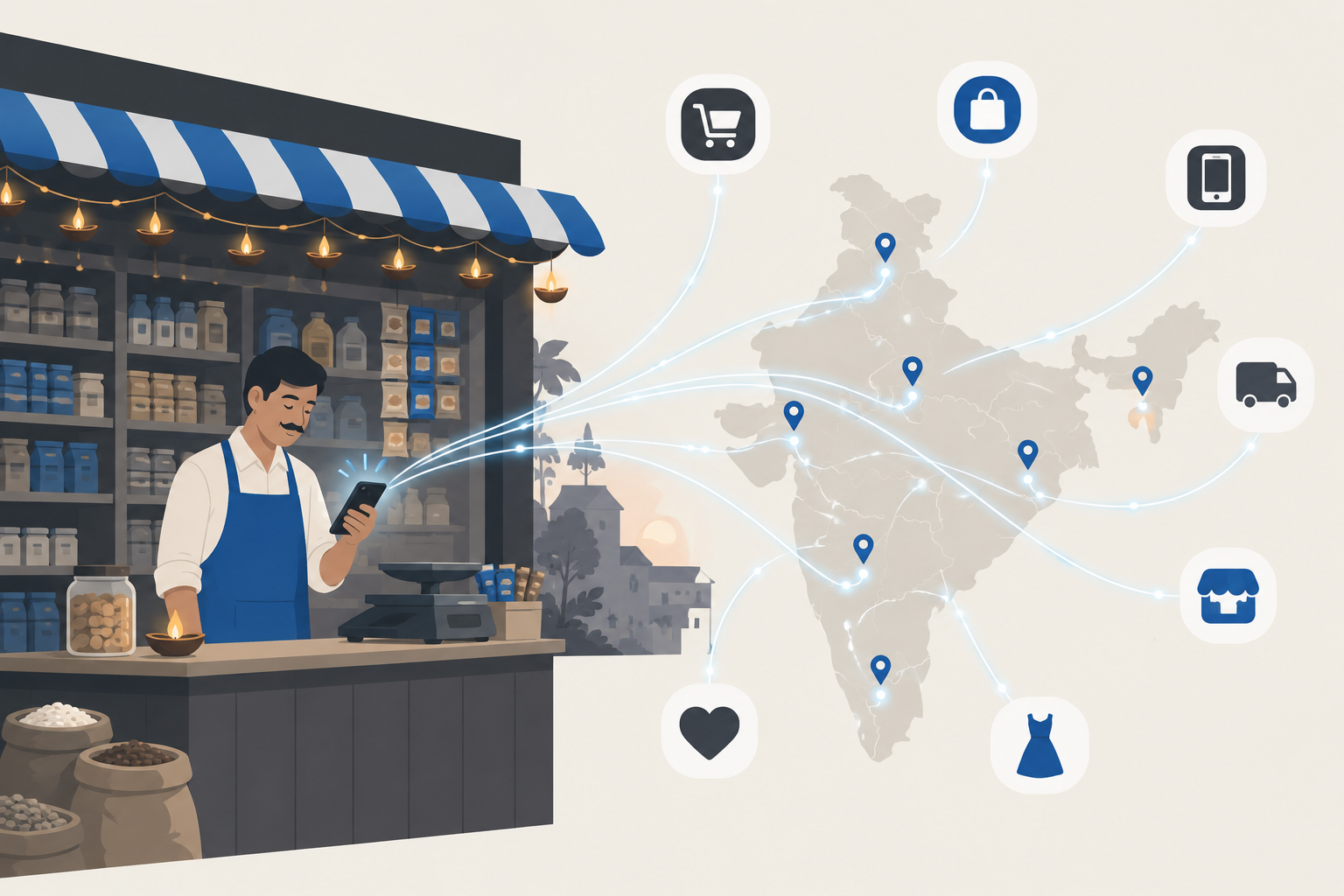
So you never "join ONDC" directly. You join one seller app, and your catalogue becomes visible to customers on many buyer apps at once. That is the main promise: list once, be found in many places.
Step 1: Check whether your category sells on ONDC#
Not every category is equal on the network. Food and grocery make up the bulk of retail orders, and hyperlocal deliveries — a customer ordering from a shop a few kilometres away — are where ONDC works best.
Good fits:
- Kirana and grocery stores
- Restaurants, sweet shops, bakeries and cloud kitchens
- Packaged food, spices, pickles, FMCG
- Local pharmacies, stationery and home-needs stores
Harder fits:
- Low-priced items that must be couriered to other states (delivery can eat the whole margin)
- Fashion and electronics, where buyers mostly still go to large marketplaces
- Anything with high return rates
Step 2: Keep your documents ready#
Most seller apps ask for roughly the same set:
- PAN (business or proprietor) — make sure it is linked with Aadhaar. If your PAN is inoperative, the TDS deducted on your sales jumps from 0.1% to 5%.
- Bank account in the business or proprietor's name, with a cancelled cheque
- GSTIN — or, if you don't have GST, many apps accept a GST enrolment number, which lets you sell within your own state
- FSSAI licence or registration if you sell food
- Udyam registration — not always mandatory, but useful
- Shop address, timings and a few clear photos
Step 3: Choose the right seller app#
This is the decision that affects your money the most. Seller app fees on the network vary widely — published rates run from about 1% to 5% per order, and some apps sell monthly plans instead. Many apps don't publish their rates at all.
Before you sign up, ask every seller app these five questions, and get the answers on WhatsApp or email:
- What percentage do you deduct, and on which amount?
- Does that include the buyer app's fee, or is that charged separately?
- Is there any monthly, listing or setup fee — now or after an introductory period?
- How often are payments settled to my bank?
- If I leave, what happens to my catalogue and pending payments?
Also check that the app publicly names a grievance officer. Every legitimate participant on the network is required to.
Watch out: No genuine seller app or agent needs to be paid to "register you on ONDC", "boost your visibility" or "release your payments". If someone asks for money upfront, walk away.
Step 4: What a ₹1,000 order really pays you#
This is where most new sellers get a surprise. There is not one fee — there are several layers, going to different parties. Here is a typical example using commonly published rates (a 3% buyer app fee and a 2% seller app fee):
| Line | Rate | Amount |
|---|---|---|
| Order value | — | ₹1,000.00 |
| Buyer app fee | 3% | −₹30.00 |
| GST on buyer app fee | 18% | −₹5.40 |
| Seller app fee | 2% | −₹20.00 |
| GST on seller app fee | 18% | −₹3.60 |
| TCS (GST) | 0.5% | −₹5.00 |
| TDS (Income Tax, 194-O) | 0.1% | −₹1.00 |
| Reaches your bank | ₹935.00 |
The TCS and TDS (₹6) are not fees — they are your own tax, deposited against your GSTIN and PAN, and you claim them back in your returns. So the true cost of this sale is about ₹59, or under 6%.
Compare that with large marketplaces and food delivery apps, where commissions plus fixed fees often take 15% to 30% of an order. That gap is the real reason ONDC is worth a look.
Delivery is separate. If you deliver yourself, it costs nothing extra. If the network's logistics partner delivers, the charge is usually passed to the customer — but confirm this with your seller app, and set a minimum order value so small orders don't lose money.
Step 5: List your products properly#
A weak catalogue is the most common reason ONDC stores get zero orders. Buyer apps show customers products, not shops, and they rank listings that look trustworthy.
- Use clear, well-lit photos on a plain background
- Write product names the way customers search ("Toor Dal 1 kg", not "TD-1KG")
- Fill in weight, pack size, MRP, and veg/non-veg for food
- Start with your 50–100 best sellers, not your entire stock
- Keep stock levels accurate — a cancelled order hurts your rating
If your billing software already holds clean product names, prices and stock, half of this work is done. Sellers who run billing on paper or in a notebook find this step the hardest.
Step 6: Bring your own customers#
This is the part nobody tells you. ONDC gives you a shop on many apps, but it does not push customers to you the way a big marketplace does. The network used to fund discounts and free delivery to attract buyers; those incentives have been cut sharply, and retail orders on the network fell after that.
The sellers who do well treat their ONDC store link like a second shop front and promote it themselves:
- Share the link on your WhatsApp status and with regular customers — a WhatsApp chatbot can send it automatically when someone asks "do you deliver?"
- Add it to your Google Business Profile
- Print a QR code at the billing counter and on carry bags
- Run a small festive offer — with Diwali on 8 November, now is the time (see our festive season checklist)
Is ONDC worth it for small sellers in 2026?#
Yes, if:
- You sell grocery, food or everyday goods and can deliver within your area
- Your stock and prices are already organised in software
- You are ready to promote your store link to your existing customers
- You want a lower-commission channel next to (not instead of) other channels
Probably not yet, if:
- You expect orders to arrive on their own after listing
- Your products are low-value and need courier delivery to other states
- You cannot keep stock updated daily
- Your returns are high or most of your buyers want cash on delivery
The honest picture: ONDC is a cheap, useful extra channel for the right kind of shop. It is not a magic switch for sales. Sellers who succeed on it usually already have a loyal local customer base — ONDC simply gives those customers a cheaper way to order.
Where Larwell fits#
We are not an ONDC seller app, and we won't pretend to be one. What we do is build the systems that make online selling actually work: billing and stock software that keeps your counter and online stock in step, your own online store so you are not dependent on any one platform, and WhatsApp ordering for your regular customers.
If you are unsure whether ONDC makes sense for your shop, talk to us. We'll look at your category, your order size and your delivery area, and tell you straight — even if the answer is "not yet".